

The real secret to making a small living room work isn't about having less stuff; it's about knowing exactly where to put it. My advice is always the same: plan before you place. Before you even think about dragging a sofa across the floor, take the time to measure your room and sketch out a floor plan. It's the one thing that will save you from a world of frustration.
This simple bit of prep work allows you to test out different layouts with paper cut-outs, rather than with back-breaking effort. It’s how you guarantee the final arrangement feels right, looks balanced, and actually works for your life.
Mastering the Floor Plan for Small Spaces
A great layout starts with a tape measure, not a shopping trip. This first step is pure problem-solving, and it’s what makes the difference between a room that feels cramped and one that feels calm and organised. Honestly, skipping this is the number one mistake I see people make, and it almost always ends with a sofa that blocks a doorway or a coffee table that’s just a little too big for the space.
Taking a moment to map everything out gives you a bird's-eye view. It helps you spot potential issues and uncover clever layout opportunities you’d otherwise miss.
Accurately Measure Your Room
First things first, you need an accurate blueprint of your living room. Grab a tape measure and get the main length and width of the space down. Just as important, though, is to document all the "unmovable" features—the things that dictate where furniture simply cannot go.
Be sure to note the exact location and size of:
- Doors and entryways, paying close attention to which way they swing open.
- Windows, and how high they are from the floor.
- Radiators, fireplaces, or any built-in shelving.
- Power outlets, TV aerial points, and light switches.
Knowing where your sockets are is more critical than you might think. There’s nothing worse than creating the perfect reading nook, only to realise the lamp cord won’t reach. These fixed points are the boundaries of your design puzzle.
Sketch Your Layout to Scale
With your measurements in hand, it’s time to get them down on paper. You don’t need any fancy software for this; a sheet of graph paper and a pencil will do just fine. Decide on a scale—say, one square equals 15cm or 30cm—and draw the outline of your room. Now, carefully add in all those fixed elements you just measured.
This simple diagram is now your sandbox. It’s where you can experiment freely with furniture arrangements without any of the heavy lifting. This whole planning process really boils down to three key actions: measure, sketch, and place.
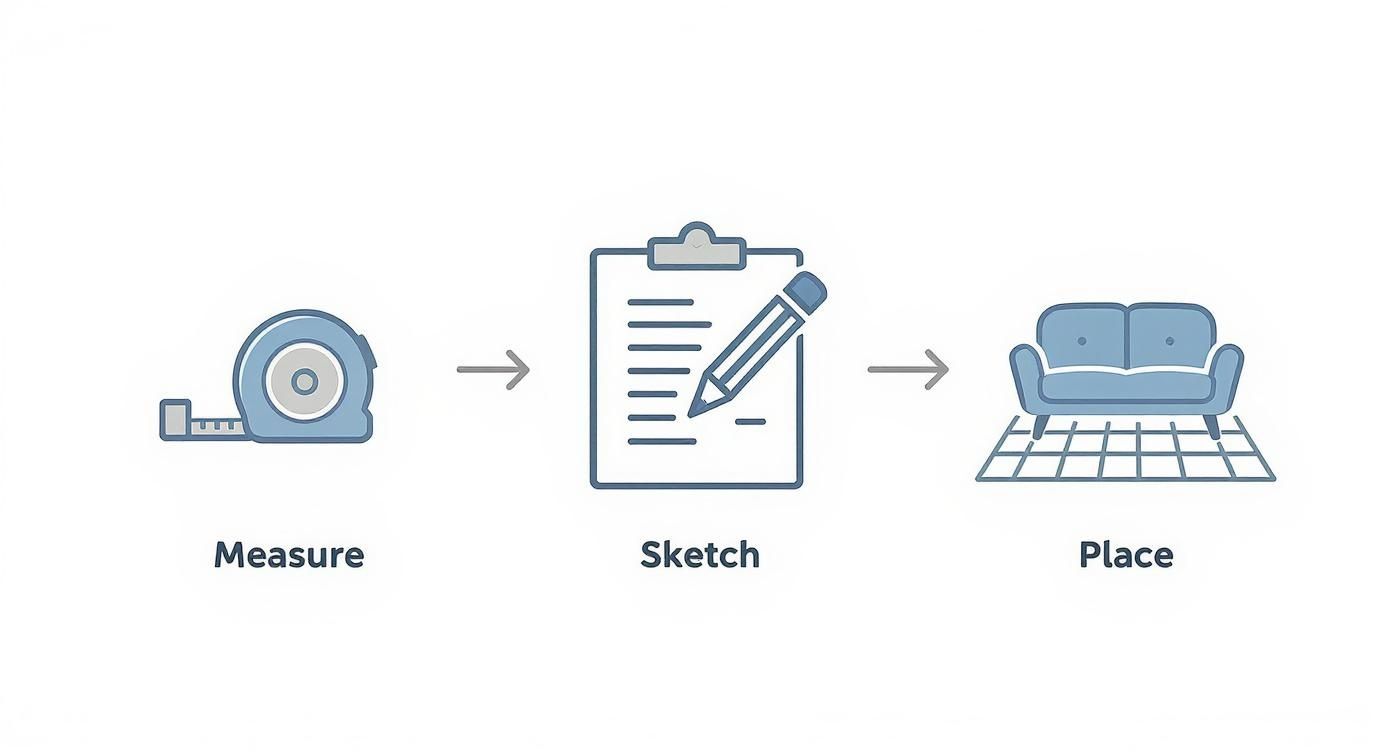
This visual guide breaks down the planning into a clear, repeatable workflow, making sure you’ve covered all the essentials before you commit.
This trend towards meticulous space planning is becoming more common across the UK, especially as compact urban living forces us to be smarter with our homes. The UK furniture market, which is set to be valued at £18.78 billion in 2025, is growing largely because of this demand for space-efficient solutions in cities like London and Manchester. You can find more detail on the UK furniture industry's growth on Market Report Analytics. At its heart, this focus on thoughtful layouts is all about making smaller homes more comfortable and functional.
Choosing the Right Furniture for Your Space
With a clear floor plan in hand, you can move on to the fun part: choosing the furniture. In a small living room, every single piece carries a lot of weight – literally and figuratively. Your selections can either create a sense of spaciousness or leave the room feeling cramped and cluttered. This isn't about being a minimalist; it's about being clever and intentional.
The two words to live by here are scale and proportion. Think of it this way: a huge, overstuffed sofa with enormous rolled arms in a tiny room is the interior design equivalent of shouting in a library. It’s just too much for the space. On the other hand, furniture with a lighter visual footprint, like a sofa with slim arms and raised legs, allows light and air to circulate underneath, which instantly makes a room feel more open.
Selecting Your Seating Wisely
The sofa is almost always the star of the show and the biggest item in the room, so getting this choice right is crucial. Before you fall in love with a standard three-seater, it’s worth exploring options better suited to compact UK homes.
Here are a few alternatives that work beautifully:
- Apartment-Sized Sofas: These are a game-changer. They’re specifically scaled down in depth and length but are designed to be just as comfortable as their larger counterparts.
- Loveseats: Perfect for really tight spots, a classic loveseat provides cosy seating for two and frees up valuable floor space for a side table or a much-needed floor lamp.
- Modular Sofas: These are your secret weapon for awkward or narrow rooms. You can arrange the individual pieces to fit your exact layout, and their adaptability means you’re not stuck if you decide to rearrange things later. For a deeper dive, check out our guide on understanding what a modular sofa is.
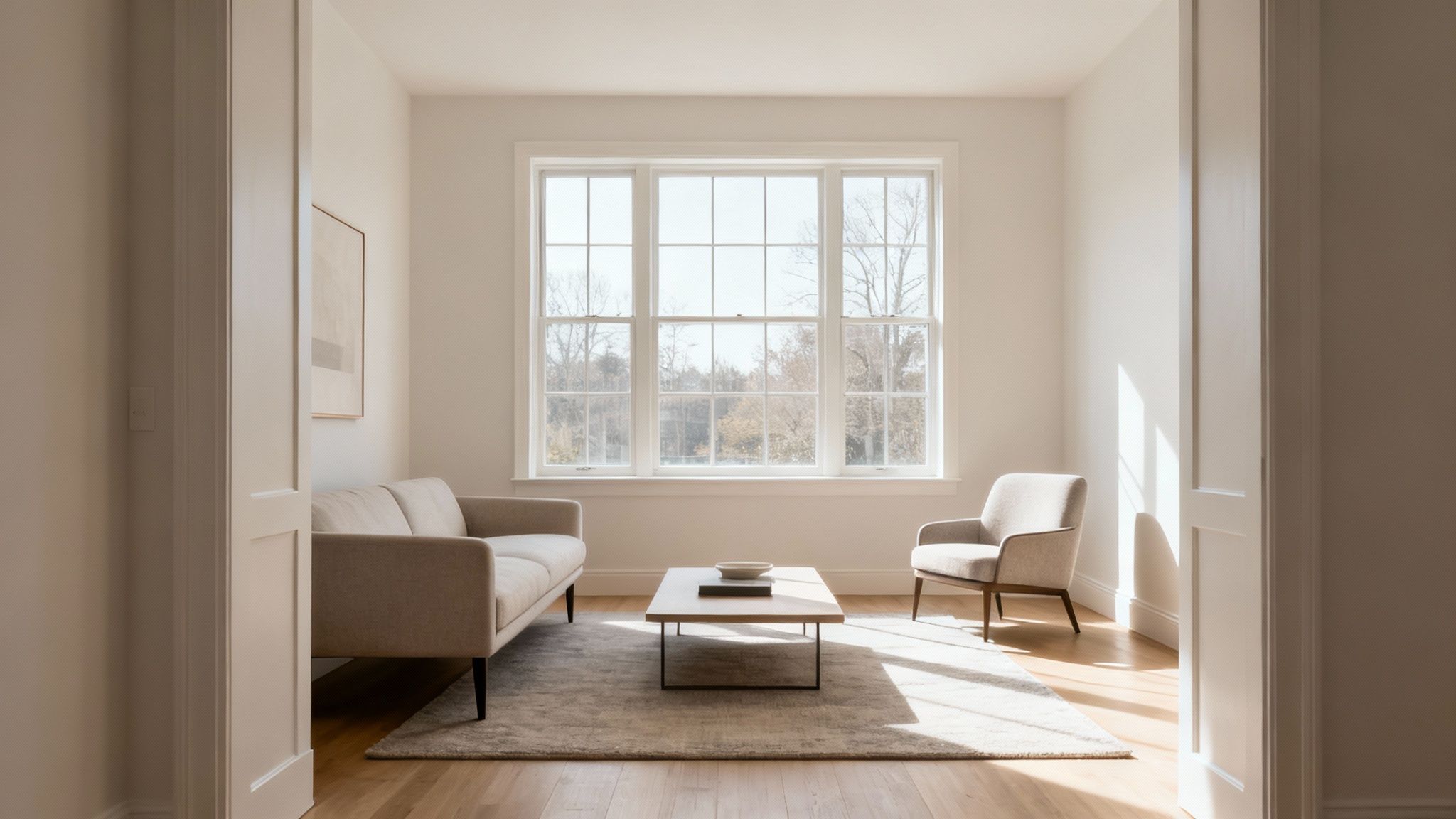
The golden rule is to pick seating that’s proportionate to the room. Always use your floor plan to map out a potential sofa’s footprint before you buy. This simple step will save you from the classic mistake of buying something that technically fits but visually swallows the entire room.
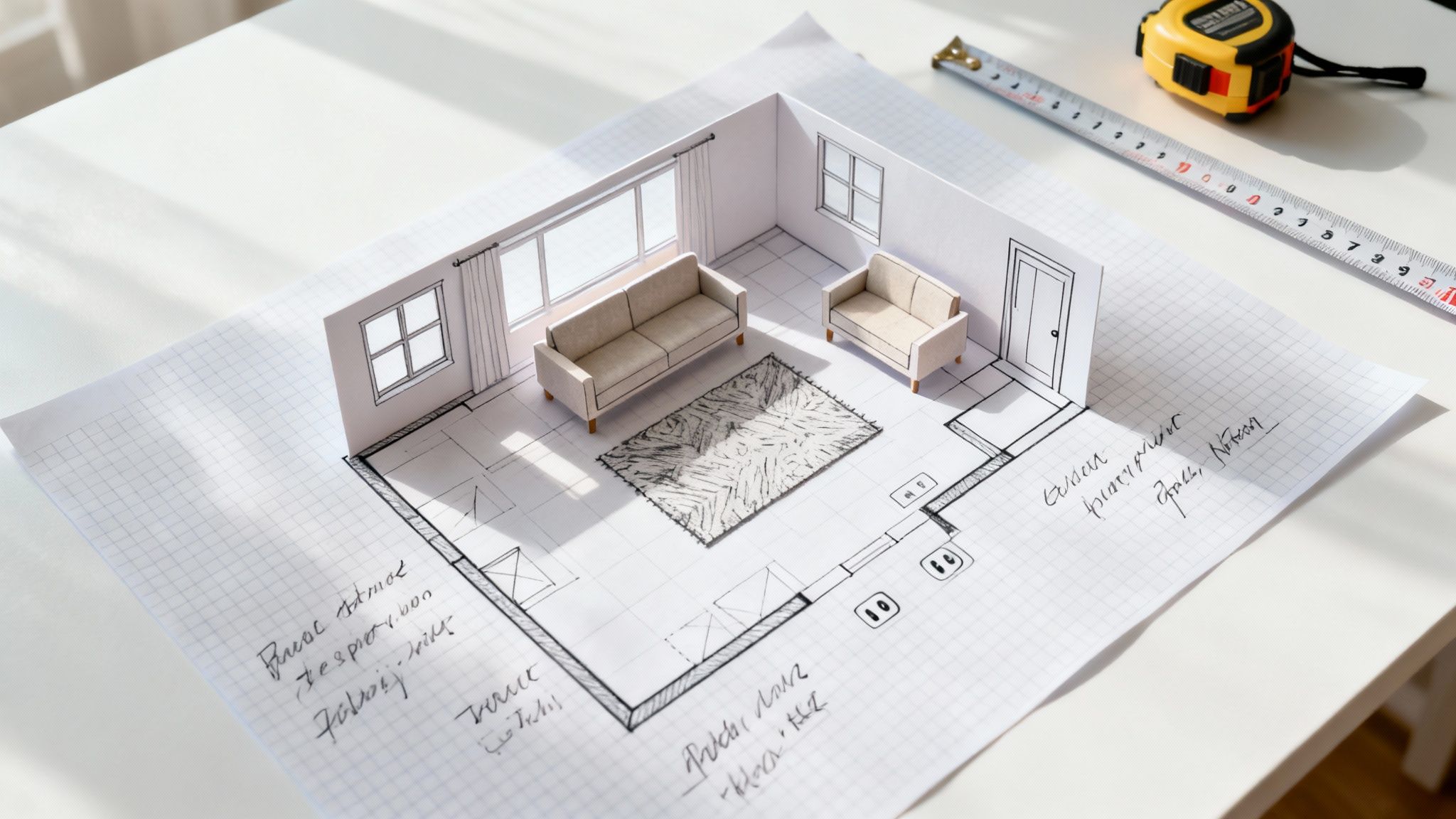
When it comes to creating the best layout, it helps to understand how different sofa styles can work for or against your space.
Small Sofa Style Comparison for UK Homes
This table breaks down some popular sofa styles to help you decide which might be the best fit for your living room's size and your lifestyle needs.
| Sofa Style | Key Features | Ideal For | Space-Saving Benefit |
|---|---|---|---|
| Loveseat | Compact two-seater design, available in various arm and leg styles. | Very small rooms, studios, or as secondary seating in a snug. | Its small footprint frees up significant floor space for other furniture. |
| Apartment Sofa | Scaled-down version of a standard three-seater; often has a shallower depth. | Narrow living rooms where a full-size sofa feels too imposing. | Provides more seating than a loveseat without overwhelming the room. |
| Modular Sofa | Consists of individual sections (modules) that can be configured in multiple ways. | Awkward layouts, rooms with tricky corners, or for those who like to rearrange. | Ultimate flexibility; you build the exact size and shape you need. |
| Sofa with Chaise | L-shaped design, typically with a built-in footrest extension. | Square-shaped rooms where you want to create a cosy, defined seating area. | Combines a sofa and footstool into one piece, reducing clutter. |
Ultimately, choosing a sofa that fits the scale of your room is the first and most important step towards a layout that feels balanced and comfortable.
Embrace Multi-Functional and Lightweight Pieces
Every item in a small living room needs to earn its keep. This is where multi-functional furniture becomes your best friend, allowing you to get more use out of fewer pieces.
Look for items that can pull double or even triple duty:
- Storage Ottomans: These are absolute workhorses. They can serve as a footrest, extra seating for guests, or a coffee table (just pop a tray on top), all while hiding away blankets, magazines, or the remote controls.
- Nesting Side Tables: Instead of one bulky coffee table, a set of nesting tables gives you incredible flexibility. You can keep them tucked together for daily use and then spread them out when you have company.
- Slim Console Tables: A narrow console behind the sofa or against a bare wall can offer a surface for a lamp and a few decorative items without eating into your precious floor space.
The materials you choose matter, too. Furniture made from glass or acrylic is brilliant for small spaces because you can see right through it, which reduces its visual weight. A glass coffee table, for example, gives you all the function without adding any visual bulk. When you pair these see-through materials with light-coloured upholstery, you help bounce light around the room, making the whole space feel brighter and bigger.
This thoughtful approach to furnishing is becoming more common across the UK, as new builds and renovations increasingly focus on making the most of smaller indoor areas. And while traditional wood materials still held 56.36% of the UK furniture market in 2024, there's a definite shift towards bespoke solutions that blend style with smart functionality. Choosing pieces that are not only the right size but also serve multiple needs is the real secret to a successful and liveable small space.
Core Principles of a Great Small Room Layout
With your floor plan sketched out and a better idea of your furniture, it's time for the fun part: arranging everything. This is where we move beyond just fitting things in and start intentionally designing a layout that feels both practical and genuinely welcoming.
Nailing a few core principles is the secret to turning a potentially awkward space into a cohesive, comfortable haven. Think of these less as rigid rules and more as the go-to techniques designers use to create balance, improve flow, and make a room feel much bigger than it actually is.
Find Your Room's Focal Point
Every great layout needs an anchor. This is your focal point—the first thing that draws your eye when you walk in and the element around which everything else is arranged. Chances are, your living room already has a natural candidate.
It could be:
- An architectural feature, like a beautiful fireplace or a large window with a killer view.
- A built-in, such as custom shelving or an accent wall.
- A functional piece, most often the media unit where your TV lives.
Once you know what it is, orient your main seating towards it. Your sofa, as the biggest piece in the room, should generally face this feature. This one move instantly gives the room a sense of purpose and order. If you’re caught between two contenders, like a fireplace and a TV, you have to decide which one gets top billing for your family's daily life.
Don't fight how you actually live. If your family gathers for movie nights far more often than they sit by the fire, it’s absolutely fine to make the television the star of the show. The best layout is always the one that works for you.
Simply choosing a focal point gives your arrangement a clear direction, stopping it from feeling random or disjointed.
Carve Out Clear Pathways
One of the biggest mistakes I see when people arrange furniture in a small living room is creating an obstacle course. You have to be able to navigate the space easily. The key is to establish clear traffic flow, those invisible lanes people use to walk through the room, from one door to another or from the sofa to the kitchen.
Think about the natural routes people will take. Nobody should have to squeeze past a coffee table or sidestep an armchair just to get across the room. As a rule of thumb, I always aim to leave at least 75cm of width for the main pathways. This ensures getting around feels effortless, not constricted.
This applies to smaller items, too. A poorly placed floor lamp or a side table that juts out can completely disrupt the flow. Your scaled floor plan is the perfect place to map these walkways out before you lift a single heavy thing.
Use a Rug to Define the Seating Area
An area rug is probably the most powerful tool in your small-space arsenal. Far from making a room feel smaller, the right rug does the complete opposite. It works by visually corralling your main furniture pieces into one unified, cohesive zone. We call this anchoring the furniture.
Getting the size right is everything. A rug that’s too small will look like a sad little postage stamp in the middle of the floor, which only makes the room feel more fragmented and even smaller.
Here's the guideline I always give my clients:
- The rug must be large enough for at least the front legs of your sofa and any armchairs to sit on it.
- Ideally, all your main seating would sit entirely on the rug, but getting just the front legs on there is a classic and effective technique.
This creates a deliberate, pulled-together conversational area. It clearly signals what the space is for and visually separates your seating zone from the surrounding pathways, which makes the whole room feel more organised and spacious.
Proven Layouts for Common Room Shapes
While every space has its own quirks, most small living rooms tend to fall into a handful of standard shapes. Instead of staring at a blank canvas, you can lean on tried-and-tested templates as a starting point. Think of these less as rigid rules and more as practical blueprints that solve the common headaches of narrow, square, or awkward rooms.
These ideas are professional shortcuts, really. They help you visualise how furniture can work together to create flow and function, taking the guesswork out of the equation and fast-tracking you to a layout that genuinely suits your home and your lifestyle.
The Long and Narrow Living Room
This is probably the trickiest shape to get right. The classic mistake? Pushing all the furniture against the two longest walls, which instantly creates a 'bowling alley' effect that feels more like a corridor than a room. Your goal is to interrupt that long line of sight and carve out distinct zones.
Here’s an approach that always works:
- Anchor with the sofa. Place your main sofa against the longest wall to ground the seating area and make the most of the floor space.
- Keep a clear path. Designate one side of the room as a clear walkway, so you can move from one end to the other without weaving around furniture.
- Add perpendicular pieces. Position an armchair or a small chaise at a right angle to the sofa. This simple trick stops the eye and breaks up that tunnel-like feeling.
A slim console table tucked behind the sofa can also work wonders, adding a useful surface and a sense of depth without eating into your precious walkway. It’s a clever way to define the living zone while keeping the room easy to navigate.
The Classic Square Room
A square room can feel a bit boxy if you're not careful, but its natural symmetry is a gift for creating a cosy, intimate atmosphere. It’s all about encouraging conversation.
The secret to a successful square room layout is pulling the furniture away from the walls. Arrange pieces to face inwards, creating a central hub that feels welcoming and perfectly balanced.
One of the best ways to do this is by placing two smaller sofas—or a sofa and two armchairs—directly opposite each other. Pop a square or round coffee table in the middle to anchor the whole arrangement. This kind of symmetrical setup feels deliberate and makes the room incredibly functional for socialising.
The L-Shaped Living Space
L-shaped rooms have become incredibly common, often blending living and dining functions. The key is to treat the two parts of the 'L' as separate but connected zones, using your furniture to signal what each area is for.
- The Living Zone: A corner sofa is your best friend here. Tucking it into the inner corner of the 'L' naturally defines the lounge area and brilliantly utilises what could otherwise be a dead spot. A modular design like the Lena 3-Seater Universal Corner Sofa is ideal, as you can configure it to fit the corner just right.
- The Secondary Zone: The smaller leg of the 'L' is perfect for a secondary purpose. This could be a small dining nook with a round table, a reading corner with a comfy armchair and a floor lamp, or even a compact home office desk.
This zoning approach is more relevant than ever. With so many of us working from home, our living spaces have to be more flexible. In fact, the demand for multi-purpose pieces has led to a 3.37% CAGR growth in home office furniture in the UK. This reflects a huge shift towards creating hybrid spaces that can do it all. You can dive deeper into these UK home furniture market trends to see how layouts are adapting. Using furniture to zone an L-shaped room is a perfect response to this modern need for versatility.
Using Lighting and Decor to Expand Your Space
A brilliant furniture layout is the foundation, but the finishing touches are what make a small living room feel truly spacious and inviting. It's the strategic use of lighting, mirrors, and decor that amplifies all your hard work, transforming a well-arranged room into a bright, airy home. These final elements are your secret weapon for tricking the eye and creating an atmosphere of genuine openness.
Getting your decor right is about so much more than just adding pretty things; it's a vital part of your spatial strategy. A poorly lit room filled with dark, heavy decor can instantly shrink the space, undoing all the benefits of a clever layout. The right choices, on the other hand, will enhance flow, add depth, and make the entire room feel bigger than its measurements suggest.
Illuminate with Intention
Lighting is one of the most powerful tools in any designer's arsenal. Instead of relying on a single, harsh overhead light, you need to think in layers. A beautifully lit room draws on multiple sources to create a balanced, welcoming ambience that eliminates dark corners.
The goal is to weave together three types of lighting:
- Ambient Lighting: This is the room's general illumination, your baseline. It might come from a central ceiling light or recessed spotlights.
- Task Lighting: This is focused light for specific activities. Think of a floor lamp beside your favourite armchair for reading or subtle under-cabinet lighting.
- Accent Lighting: This is all about highlighting features you love, like a picture light over a piece of art or an uplighter tucked behind a plant to create a soft glow.
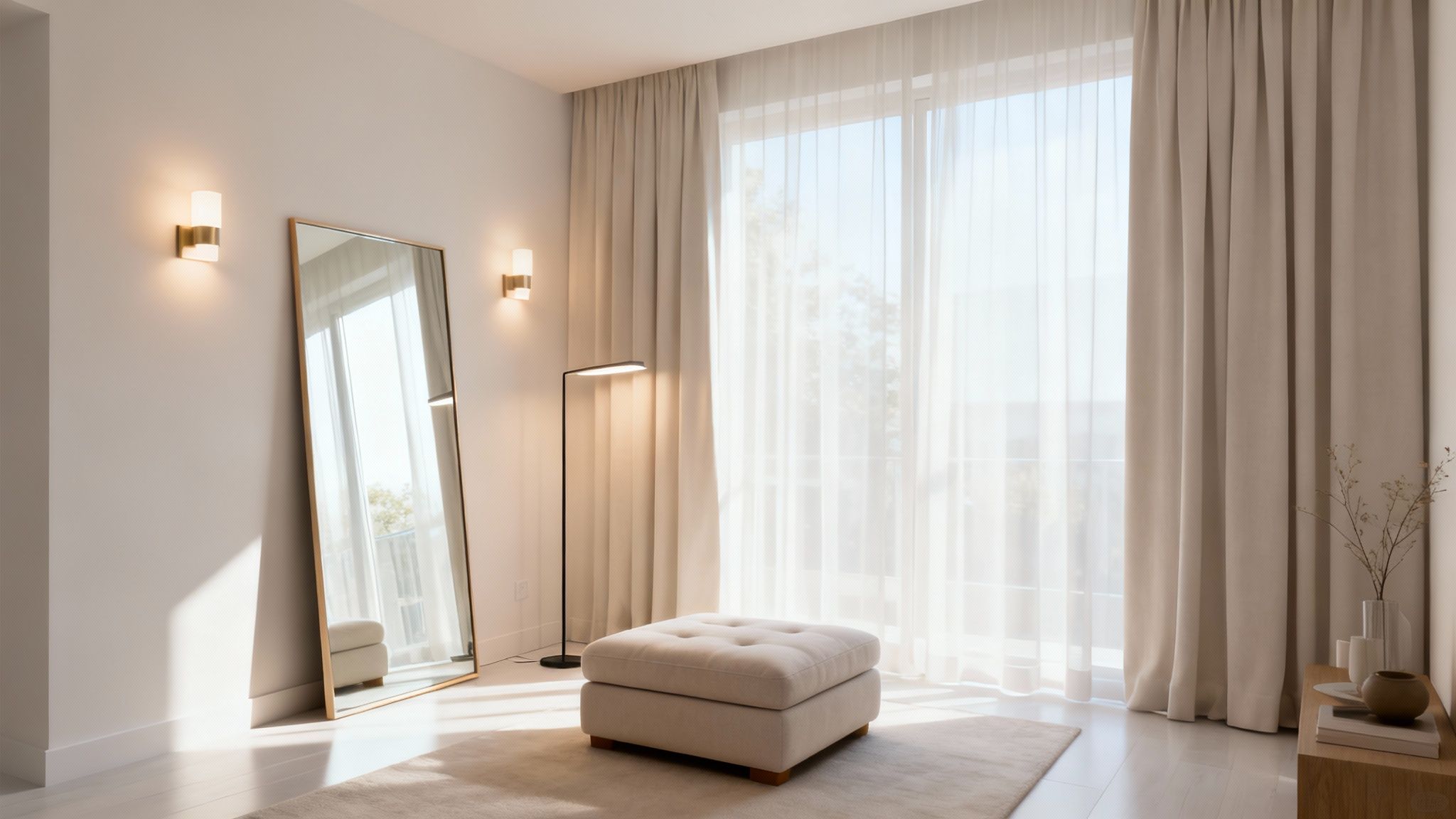
By layering these sources, you draw the eye around the room and, crucially, upwards. This movement creates a feeling of height and space. Wall sconces are a fantastic choice here, as they provide beautiful ambient light without taking up a single inch of floor or surface space. A slim, elegant arc floor lamp can also work wonders, providing targeted light over a coffee table while keeping its own footprint to a minimum.
Create Illusions with Mirrors and Decor
Beyond lighting, your decor choices play a starring role in the perception of space. The number one trick in the book? Mirrors. A large mirror placed opposite a window is a classic designer move for a reason—it bounces natural light all around the room and creates a powerful illusion of depth. It's almost like adding a second window.
Try placing a mirror behind a lamp to amplify its glow in the evening or grouping a collection of smaller mirrors to create a reflective feature wall. The key is to position them to reflect something you want to see more of, whether that's daylight, a beautiful view, or the soft light from a favourite lamp.
A well-placed mirror doesn't just reflect a room; it enlarges it. Think of it as a tool for pushing back the walls and amplifying every source of light you have, making it one of the most effective investments for a small space.
Smart decor also extends to your textiles and accessories. When hanging curtains, always mount the rod higher and wider than the window frame. This simple trick makes the window appear much larger and allows maximum daylight to flood in when the curtains are open. Opt for a cohesive, light colour palette for your walls and main furniture pieces to create a calm, uncluttered backdrop. You can then introduce pops of colour and texture with cushions, throws, and artwork.
Even smaller items can pack a punch. A versatile piece like the Lena Footstool can add a touch of colour while offering flexible extra seating or a handy surface for a tray, proving that even functional items can contribute beautifully to your overall decor scheme.
Common Questions About Small Living Rooms
Even with the most careful planning, every small living room throws up its own unique puzzles. After years of designing these spaces, I’ve seen the same questions and challenges come up again and again. This is where we tackle those frequent dilemmas, with straightforward advice to help you fine-tune your layout.
Think of this as your troubleshooting guide. We'll get into the classic design debates, like how to handle a TV and a fireplace, and clarify those little details that make a huge difference, like rug sizing and sneaky storage. My goal is to give you the clarity you need to nail down an arrangement that’s not just beautiful, but genuinely works for your life.
How Can I Arrange Furniture With Both a Fireplace and a TV?
Ah, the classic layout conundrum. With two major focal points competing for your attention, it’s easy to feel stuck. The very first thing to do is be honest with yourself: how do you actually use the room? Your answer will dictate the entire setup.
If your family is all about movie nights, then the television has to be your primary focus. In that case, you’ll want to orient your main sofa to face the TV directly. To bring the fireplace into the fold, you can place one or two armchairs at an angle, creating a secondary conversation spot that can enjoy both the screen and the warmth of the fire.
On the other hand, if the fireplace is the true heart of your home, you've got a couple of elegant options:
- Create a single focal point: Mounting the television above the fireplace mantel is a very popular solution. It instantly solves the problem by consolidating the room's focus, allowing all your seating to face one direction.
- Use an adjacent wall: Another great strategy is to put the TV on a low console on a wall perpendicular to the fireplace. Then you can arrange your seating in a classic L-shape, which lets you comfortably view both features without any awkward neck-craning.
The trick is simply to avoid a setup where you have to twist uncomfortably to see the screen. An L-shaped or modular sofa is often the perfect, flexible piece to solve this puzzle.
What Is the Biggest Mistake to Avoid in a Small Living Room?
Without a shadow of a doubt, the most common mistake I see is people pushing all their furniture right up against the walls. It’s an understandable instinct—you think you’re creating more open floor space. But in reality, it just makes the room feel stiff and boxy. It can actually make the space feel smaller.
The secret is to create a little ‘breathing room’. Pulling your sofa and chairs even a few inches away from the walls creates a subtle shadow line that tricks the eye, giving the illusion of more space. It’s a tiny adjustment that has a massive visual payoff.
The second biggest misstep is choosing furniture that’s completely out of scale. One huge, chunky sofa can visually swallow a small living room, making it feel cramped no matter what you do. Always look for pieces with a lighter visual weight, like sofas with slim arms and raised legs that let you see the floor underneath.
Do I Need an Area Rug and What Size Should It Be?
Yes, absolutely. An area rug isn't just decoration; it's a foundational piece of your layout, especially in a compact room. A rug's main job is to anchor the furniture and define your main seating zone, visually pulling everything together into a cohesive, intentional group.
The cardinal sin here is choosing a rug that's too small. A tiny rug floating like a postage stamp between your furniture only makes the room look disjointed and smaller.
Just follow this one simple rule for sizing:
The rug needs to be large enough for at least the front legs of your sofa and all of your armchairs to sit comfortably on it. This creates a deliberate, well-designed conversation area and makes the entire space feel more organised and expansive.
How Can I Add Storage Without Creating Clutter?
In any small room, smart storage is non-negotiable. The trick is to integrate it so seamlessly that it doesn't add any visual bulk. The best way to do this is by thinking vertically and choosing multi-functional furniture.
Look up, not out. Instead of a wide, low TV unit, maybe a taller, slimmer bookcase would work better to draw the eye upward. Floating shelves are also brilliant for displaying treasures or storing books without consuming a single inch of precious floor space.
Here are a few of my favourite hard-working pieces:
- An ottoman with hidden storage is the ultimate multi-tasker. It’s a footrest, extra seat, and a place to stash blankets or magazines all in one.
- A coffee table with drawers or a lower shelf gives you a spot to tuck away remotes, coasters, and all those little bits and bobs.
- A slim console table behind the sofa can hold a lamp or two while letting you hide storage baskets underneath, completely out of sight.
By making your furniture work harder, you can keep your living room feeling open, organised, and ready for anything.
At Elite Sofas UK, we understand the unique challenges of furnishing smaller UK homes. Our collection of modular sofas, apartment-sized seating, and clever ottomans is designed to help you create a stylish and functional living space, no matter the size. Find your perfect fit and transform your room by visiting us at https://www.elitesofas.uk.
Article created using Outrank


